One year of the Marcos Jr. administration has meant an abundance of platitudes on climate and environmental action, and little actual progress for ecologically-sustainable development. Under Marcos Jr, the same business-as-usual, foreign-dominated, and export-oriented economic model continues to shape our path forward, leading to devastation for both people and planet.
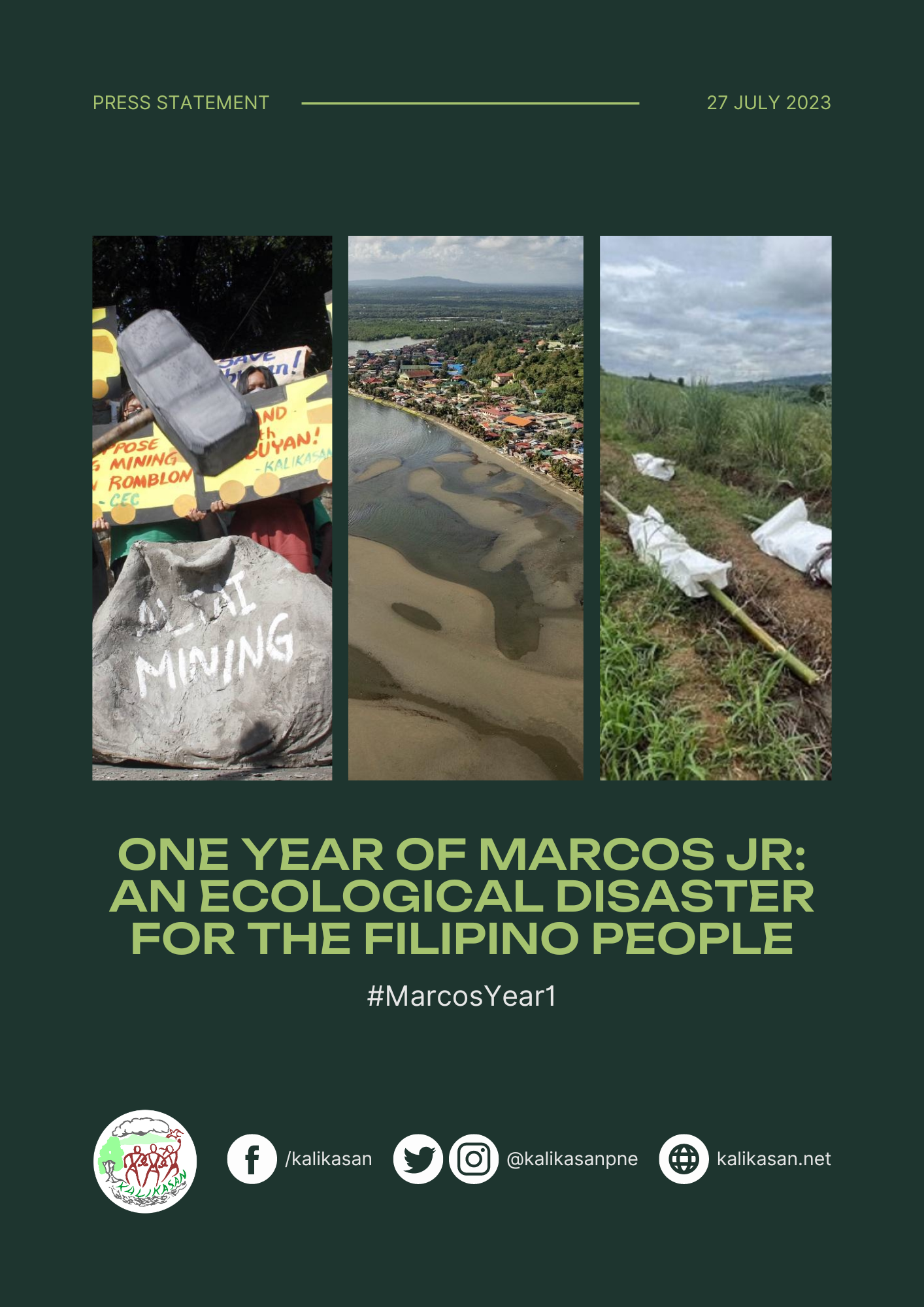
In recent months, environmental issues left and right have captured the attention of the Filipino people. Under the framework of the Mining Act of 1995 and its longstanding issues, Marcos Jr. has pledged the expansion of the mining industry in the country, paying little heed to the concerns of communities and environmental groups. The case of Sibuyan Island and the struggle against Altai Philippines Mining Corporation’s operations — a company granted permits under the Marcos Jr. administration — reveals the backward nature of mining policies Marcos Jr. has committed himself to continuing at all costs.
One of the worst oil spills in Philippine history, the Mindoro oil spill, also revealed the abject failure and criminal neglect on the part of the Marcos administration to respond to the economic crisis generated by ecological disasters such as this. Fisherfolk in Mindoro Oriental have faced months of suffering “worse than the COVID-19 lockdown” due to a blanket fishing ban and little to no ayuda, leading to physical and psychological distress across communities. The push for accountability and necessary reforms has also moved at a snail’s pace, leaving communities and critical ecosystems like the Verde Island Passage vulnerable to future disasters.
The issue of reclamation has also been a hot topic under the current administration. Recent steps in the right direction, such as the Philippine Reclamation Authority decision not to accept any new reclamation project applications, are products of months of collective action, community work, and dialogue. However, ongoing dump-and-fill projects still threaten to reshape coastal habitats and communities, erasing critical mangrove, seagrass, and coral areas while cutting off hundreds of thousands of fisherfolk from their livelihoods. Emblematic cases such as San Miguel Corporation’s New Manila International Airport have been the subject of critical local and international reports documenting environmental and human rights violations. Despite all this, the Marcos Jr. administration appears to have committed to their self-interested vision of development, to the detriment of millions of Filipinos.
Dam projects such as the Kaliwa-Kanan-Laiban Dam, the Gened Dams, and the Jalaur Dam have also continued in the first year of the Marcos Jr. administration. In the face of significant opposition from indigenous communities and civil society organizations, state institutions such as the National Commission on Indigenous Peoples have resorted to blatant red-tagging and distortion of Free Prior and Informed Consent processes to ensure the continuation of such projects.
Militarization and military expansion in myriad forms have also colored the first year of Marcos Jr’s rule. Escalating geopolitical tensions between imperialist powers US and China have warranted, in the administration’s eyes, the increased presence of US military forces in our country. This is despite the attendant and potential human rights and ecological costs of additional US military presence, and clear calls from civil society for non-alignment and peace in the region. In rural areas, militarization has led to several cases of indiscriminate aerial attacks and bombings in communities, resulting in untold ecological devastation in key biodiversity areas, on top of human rights violations numbering in the hundreds or thousands per incident.
The Marcos Jr. administration has also continued to do little despite all the talk of climate change and the need to respond to its challenges. Hundreds dead from typhoons and shear line rains reveal the continued policy of neglect of the administration in terms of disaster preparedness and response in the face of the changing climate. This gives the Filipino people little comfort in the face of the coming El Niño season, which will only lead to untold suffering should the Marcos Jr. administration fail to respond adequately.
With regards to climate change mitigation, things are hardly better. On top of the selectively anti-people implementation of emissions reduction measures such as the forced PUV Modernization program, Marcos Jr. somehow still takes pride in his declaration of the expansion of the fossil gas industry as a priority of his administration.
Despite our position as one of the worst countries in the world in terms of climate risk and impacts, the administration has also failed to rock the boat in demanding just and genuine reparations from industrialized countries for damages brought about by global warming and climate change. Calls for sufficient climate finance — even the minimum demand of USD 100 billion a year to the Global South — have not been a consistent demand point of the Philippines internationally. Instead, we see Marcos Jr. flying to other countries to beg for “green” loans and investments.
All of this has taken place amid a backdrop of continuing and escalating human rights violations against those in the frontlines of defending the planet. Land and environmental defenders have continuously been attacked and threatened for their work, with recent months documenting an increase in abductions, disappearances, and killings of such advocates. The disappearance of indigenous rights advocates Bazoo de Jesus and Dexter Capuyan, and the recent killings of land defenders in Negros are only a few examples of relentless persecution environmental defenders have faced under the Marcos Jr. administration. Despite this, the administration has refused to recognize the ongoing crisis faced by land and environmental advocates in our country, instead defaulting to senseless red-tagging and vilification campaigns to justify human rights violations.
It is increasingly obvious that Marcos Jr. and his administration have simply continued the ecologically-disastrous legacies of previous administrations despite attempts to greenwash aspects of his rhetoric and rule. With all the promises, one year of Marcos Jr. has been nothing but an ecological disaster for the Filipino people. In the face of our ecological crisis, we continue to call on other environmental and civil society groups to oppose the backwards policies of the Marcos Jr. administration, and push for a sustainable and just future for all! #