Kalikasan People’s Network for the Environment
Statement
June 28, 2025
Six years after its suspension in Brgy. Didipio, Kasibu Town, Nueva Vizcaya, OceanaGold Philippines Inc. (OGPI) has once again returned, now planning underground exploration activities. But as before, it will surely be met with the organized resistance of communities who have long endured environmental destruction, displacement, and militarization.
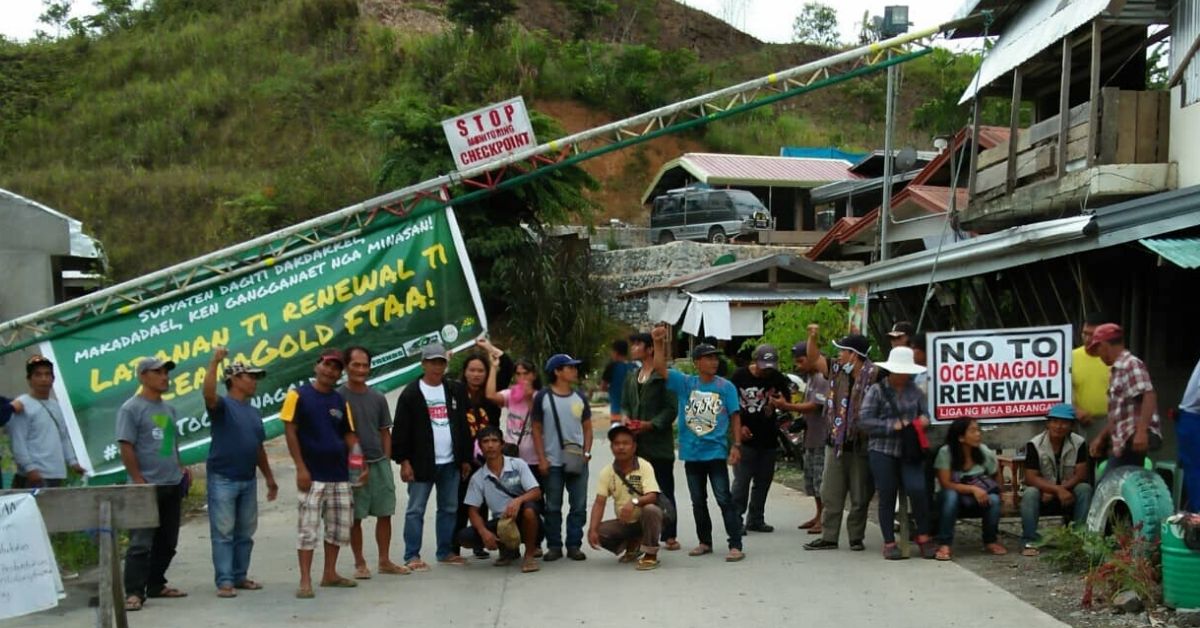
OceanaGold’s legacy in Nueva Vizcaya is one of violence and ecological destruction. Its operations depleted community water sources, reduced agricultural productivity, and damaged forests and farmlands, among numerous other violations of people’s rights. The enforcement of its suspension was a hard-won victory, born of years of struggle, mass actions, and the establishment of the people’s barricade, an act of defiance that continues to inspire nationwide resistance.
Now, OGPI is attempting a comeback, justified under the guise of legality and “limited” exploration. OGPI said around 8,000 meters of drilling is planned from surface across its financial or technical assistance agreement (FTAA) area at True Blue, which it considers as a potential off-set extension to the Didipio Mine, Napartan and D’Fox sites. But no amount of legal maneuvering can erase the harm and destruction inflicted by the company on the people and the environment.
But what enables this persistence of plunder? OceanaGold finished its mining permit in 2019 and was then renewed by former Philippine president and current criminal Rodrigo Duterte in 2021 for another 25 year mining permit. State institutions such as the Department of Environment and Natural Resources (DENR), the Mines and Geosciences Bureau (MGB), and above all, the US-Marcos-Duterte regime, actively protect and promote mining interests. Alongside local elites and foreign corporations, they are complicit in a system of legalized exploitation.
Laws like the Philippine Mining Act of 1995 serve as key instruments of this plunder, stripping away the power of local governments and communities to enforce their own mining bans, even when they have seen firsthand the irreversible damage caused by large-scale mining operations.
At its core, the Mining Act is a sham legal framework that protects the dominance of foreign and bourgeois comprador interests over the welfare of affected communities and the protection of the environment. Mining lords such as Martin Romualdez of Benguet Corp., Ronald Zamora of Nickel Asia, Villar Family of TVI Resource Development, and Gilberto Teodoro Jr. of Sagittarious Mines Inc. continue to profit, while affected communities and defenders of land and life are harassed, red-tagged, or worse, killed.
Yet the people remain undeterred. Across communities affected by militarization and plunder, grassroots organizing continues to grow and deepen. In Mindoro, the people continue to reject mining projects operated by Agusan Petroleum. In the mountains of Cordillera, and in Palawan, Zambales, and beyond, large-scale mining remains met with sustained community resistance.
This struggle is not only against corporate greed, but against imperialist plunder that threatens our lands, resources, and lives as disposable in the name of profit. It is a system upheld by local ruling elites, foreign mining giants, and a government that serves foreign and comprador interests over the Filipino people. Kalikasan People’s Network for the Environment calls on all Filipino people to remember and echo the calls of communities who rose against the destructive OceanaGold and other similar people’s struggle.