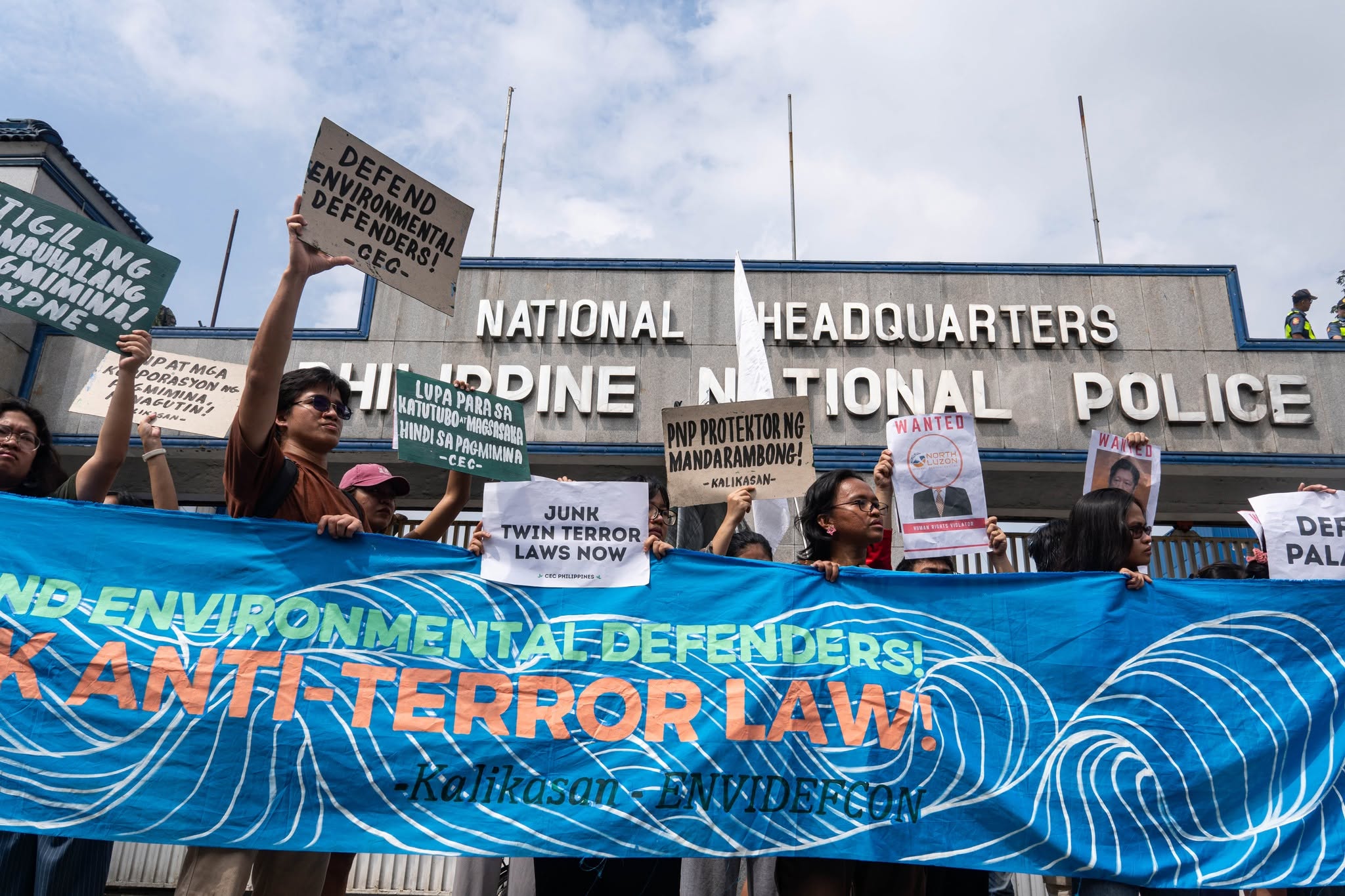
QUEZON CITY — Environmental defenders and community advocates held an action today at the Philippine National Police (PNP) headquarters in Quezon City to protest the continuing attacks against communities resisting large-scale mining and destructive projects across the country.
Led by the Kalikasan People’s Network for the Environment, the action called attention to the grave human rights violations faced by environmental defenders and communities asserting their right to protect their lands and natural resources.
The protest comes amid continuing documentation of violence against environmental defenders in the Philippines. For 13 years, the Philippines has been tagged as the most dangerous country for environmental defenders in Asia. In its latest report covering 2025, Global Witness recorded 12 killings of land and environmental defenders in the Philippines—the highest number recorded outside Latin America. The organization also identified the Philippines as the country in Asia-Pacific where most of the region’s documented killings occurred in 2025.
Among those recorded were Ali Jejhon Macalintal, Davie Ugking, Fernando Promboy, Hulyo Agtay, Joan Escuadro, Juan Sumilhig, Nickasio Tayas Mindo, Ramon M. Lupos, Rico Gonzaga Malubay, Rudolph Dela Cruz Espe, Veronico Anterio, and Warlita Jimenez.
The killings of anti-mining activists Rico Gonzaga Malubay and Rudolph Dela Cruz Espe, grassroots paralegals and community leaders in Davao Oriental, further underscored the risks faced by communities opposing extractive and destructive projects. The two were shot dead in Banaybanay in July 2025.
Global Witness also documented the increasing use of criminalization against environmental and land defenders in Asia, noting that in the Philippines red-tagging remains a significant mechanism used to portray defenders as communists or terrorists. Its research with FORUM-ASIA documented hundreds of arrests and detentions of defenders across the Philippines, India, Indonesia, and Vietnam between 2018 and 2024.
Recent emblematic cases include the rabid filing of SLAPP cases against anti-mining advocates in Kasibu and weaponization of law through made up charges and arbitrary terrorist accusations on 11 activists in Cagayan Valley.
Mining expansion, critical minerals, and the widening pressure on communities
The attacks against environmental defenders are taking place alongside an aggressive push to expand the country’s mining and critical minerals industry.
The Marcos administration has increasingly positioned Philippine mineral resources as strategic assets in global supply chains. The Philippines has likewise joined the US-led Pax Silica initiative, which the Philippine government presents as a framework for cooperation on critical minerals, semiconductors, advanced manufacturing, and artificial intelligence. The Philippines and the United States have also signed a Memorandum of Understanding on securing the supply of critical minerals for the imperialist war and offensive of the US, leading to the enactment of Executive Order 122. Signed in August 2026, EO 122 establishes a national policy framework for developing the critical minerals industry and mobilizes government agencies to permit easy entry and fast-tracking of applications of foreign extractive operations in the country. The Mines and Geosciences Bureau has also been tasked with exploring prospective areas across the approximately 9 million hectares of mineralized land, comparable to the size of Mindanao.
These developments raise questions about what happens to communities whose territories overlap with areas identified for mineral development. Environmental and indigenous rights groups have warned that the expansion of critical-minerals development could increase the already worsening threats on ancestral domains, agricultural land and ecologically important areas.
The government describes these initiatives in terms of industrialization and participation in global technology supply chains, but communities on the ground are asking a more fundamental question on whose lands and whose lives will bear the cost of this mineral expansion?
Whole-of-government plunder
Environmental defenders also point to the increasingly coordinated role of government agencies in facilitating extractive projects while communities face intensified restrictions and pressure.
The expansion of extractive projects in the country fundamentally involves the coordination of agencies responsible for the environment, energy, ancestral domains, land, infrastructure, investment, and local governance. Under the Marcos administration’s critical-minerals framework, government agencies are being tasked to harmonize policies and streamline processes related to mineral development.
For communities resisting destructive projects, however, this expanding coordination is accompanied by a shrinking space for protest.
The experience of environmental defenders shows how counterinsurgency and resource extraction can converge on the same communities. Global Witness has documented how the Philippine government’s counterinsurgency campaign has coincided with violence against defenders, including five of the 12 killings it recorded in 2025 involving suspected participation by members of the armed forces. It also reported that criminalization and red-tagging continue to be used against defenders who challenge powerful interests.
This pattern is particularly alarming in indigenous and rural communities where resistance to large-scale projects is often rooted in the defense of communities and the environment.
The right to protest is not a crime
The environmental defenders who gathered today at the PNP headquarters asserted that communities should not have to choose between defending their livelihoods and protecting their lives.
Communities and advocates have the right to organize express opposition to defend their communities without being treated as falsely incriminated by the state.
The continuing criminalization and violence against defenders proves that communities may be punished for standing in the way of projects backed by powerful political and economic interests, evident in the systematic mobilization of repressive state institutions to attack communities, including state forces and legal institutions, through fabricated charges, terrorist accusations, and relentless intimidation
Environmental defenders are therefore calling for an end to the use of state forces and criminal proceedings to suppress peaceful opposition, and for genuine accountability for killings and attacks against defenders.
As the government accelerates its critical-minerals agenda and seeks a larger role for the Philippines in global mineral and technology supply chains, communities insist that environmental protection and human rights cannot be treated as obstacles to investment.
The right to defend the land is the right to defend life. The right to protest is a fundamental right, never a crime.