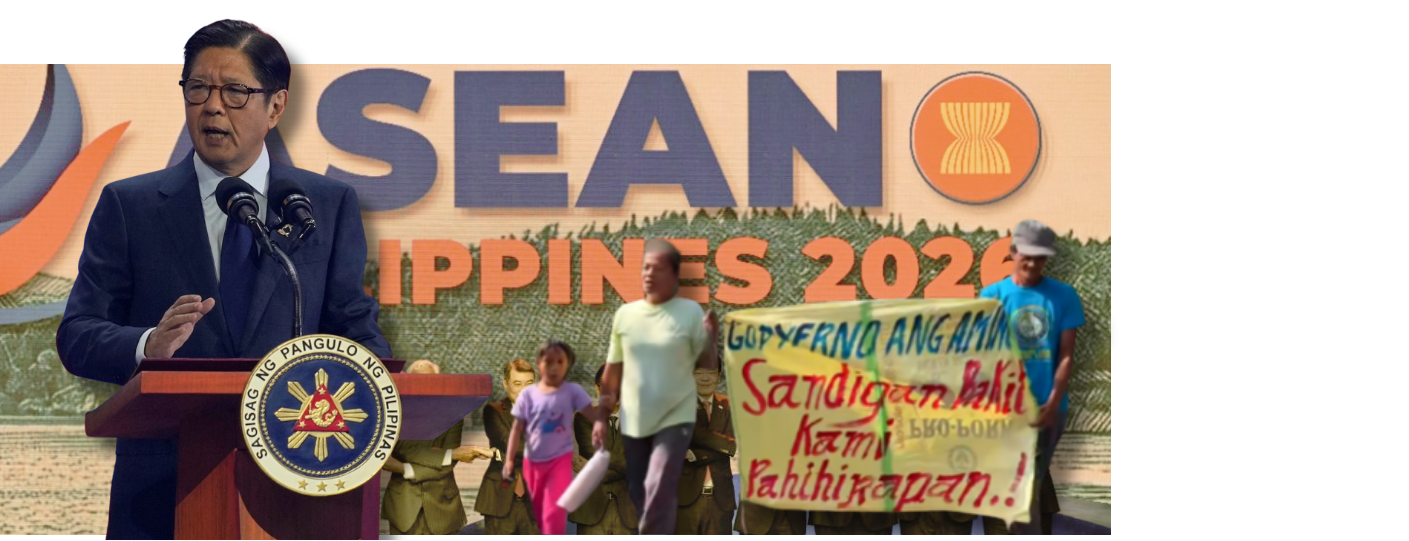
The 48th ASEAN Summit in Cebu opens with hollow rhetoric on “green growth” and regional unity, yet beneath these declarations lies a dangerous expansion of the same neoliberal and imperialist frameworks that have long deepened the climate crisis and impoverished our peoples. Kalikasan decries these declarations as repackaged mechanisms for corporate plunder and geopolitical control.
President Ferdinand Marcos Jr.’s call for expanded Public-Private Partnerships (PPPs) under the BIMP-EAGA Vision 2035 signals an aggressive push for privatized, profit-driven development. With 265 infrastructure projects amounting to USD 174.6 billion across the subregion, including the Laguindingan Airport Development and the Mindanao-Visayas Interconnection Grid, this agenda prioritizes large-scale construction and foreign capital over genuine national development. These projects move forward despite unresolved corruption issues, echoing the same infrastructure-heavy, debt-driven model that historically enriched elites while displacing communities and degrading ecosystems.
True energy security cannot be built through privatization and increased foreign dependence. It requires a sovereign, state-led industrialization program that prioritizes public ownership of energy resources, genuine technology, and development that serves national interest and not the profit motive of multinational corporations. Instead, the Marcos Jr. administration continues to anchor the country in import dependence and export-oriented energy systems, leaving Filipinos vulnerable to global price shocks and geopolitical tensions intensified by U.S.-led wars and interventions.
We unequivocally condemn the Marcos administration for its complicity in the United States’ geopolitical maneuvering under the deceptive guise of “Pax Silica,” a strategy that prioritizes American military dominance and semiconductor supply chains over the welfare of Filipino communities. This administration’s push for so-called “green” energy projects is nothing more than greenwashing. These projects facilitate land grabbing for mining and large-scale renewable installations that displace indigenous peoples and small farmers, all while serving US strategic interests in the Indo-Pacific rather than the nation’s true climate and energy needs.
Marcos Jr. ‘s appeal for ASEAN unity and cohesion amid a supposed “defining moment” for the region rings hollow. While he speaks of addressing global conflicts and instability, his administration refuses to pursue meaningful peace talks within the Philippines. How can a government claim to advocate for regional peace while perpetuating internal armed conflict and rejecting pathways toward just and lasting peace at home?
The Summit’s emphasis on trade liberalization, including proposals such as increased rice importation from Vietnam, further exposes the bankruptcy of ASEAN’s development model. Reliance on imports is not a solution to food insecurity—it is a surrender of national sovereignty. It entrenches dependency, exposes the country to volatile global markets, and undermines local farmers. Genuine food security requires comprehensive land reform, substantial state investment in irrigation and rural support, and protection of domestic producers from import liberalization policies.
Across these issues, a clear pattern emerges: the ASEAN Summit promotes false, greenwashed solutions that entrench corporate control, foreign domination, and ecological destruction, all while masking these under the language of sustainability and cooperation.
We therefore call on the ASEAN community and the Filipino people to reject these deceptive frameworks and imperialist agendas, uniting instead to fight for a future defined by genuine national sovereignty, ecological justice, and the liberation of our lands and livelihoods from the grip of foreign domination and corporate greed.